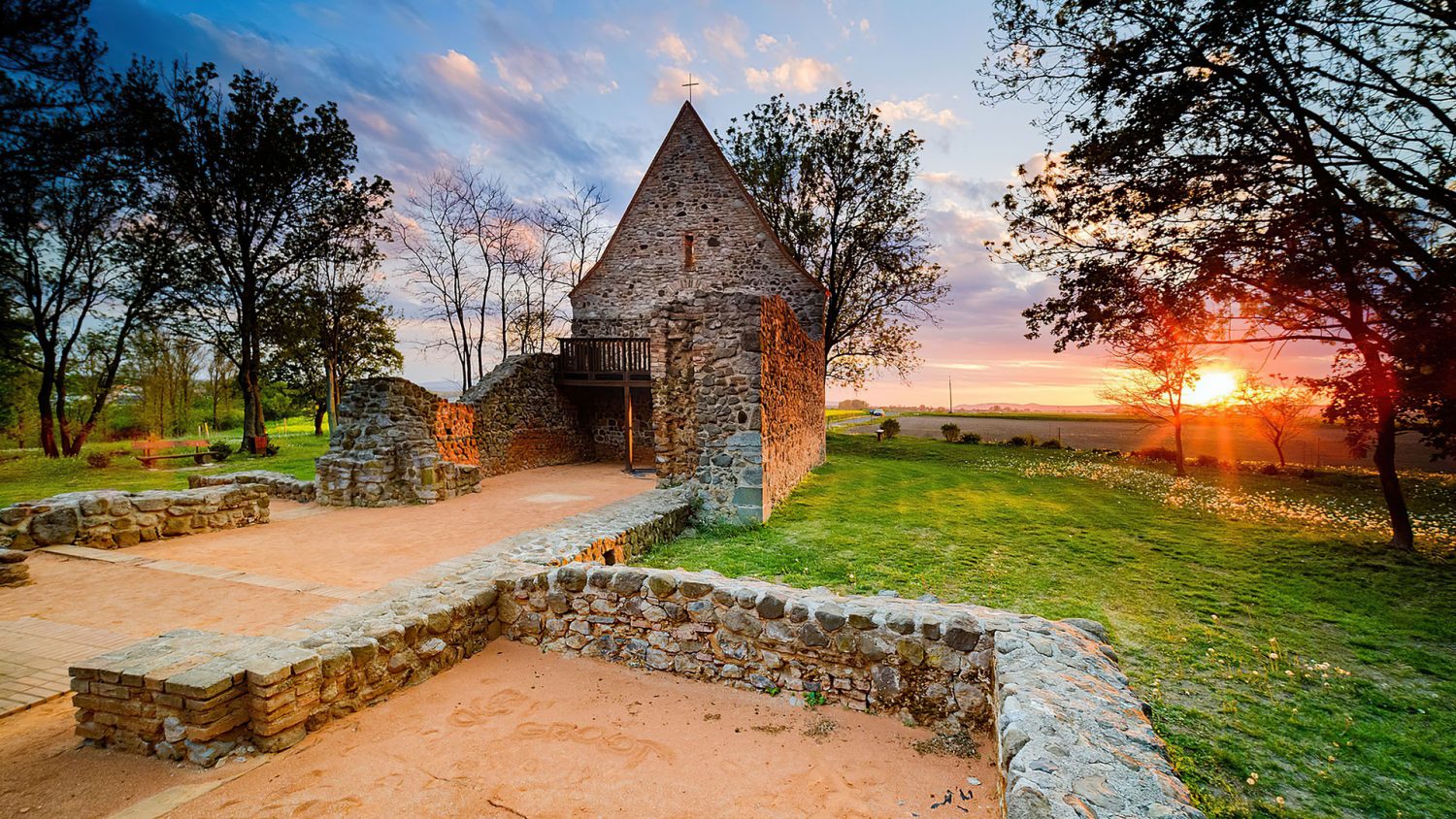


Fiľakovo
While walking through the town of Fiľakovo, you certainly won’t miss the massive stronghold of Fiľakovo Castle.
The origin of the castle dates back to the 13th century and is attributed to the Kačič family. Later, however, it was owned by several proprietors, the best known being the Bebek family, Matthew Csák of Trenčín, and Matthias Corvinus.
It was built on a rocky hill and, thanks to its towers, bastions, and 6-meter walls, had an excellent defensive position. During its existence, it was rebuilt several times and additional ramparts and gates were added.
However, even its defensive mechanisms were not enough to withstand the attack and conquest by the Turks and in the 16th century the castle succumbed to pressure. The Turks settled inside it for a full 40 years and ruled the surrounding land from there. After some time, the castle was recaptured, but peaceful times did not last long, because the castle burned down. From then on, it lost its importance, and only ruins have remained ever since.


Šomoška
The border castle of Šomoška, rising on the border with Hungary immediately reveals its massive cylindrical tower, for which it is characteristic.
It was built in the 13th–14th centuries during the Tatar incursions into this territory. Interestingly, local material was used for its construction, namely basalt columns.
The original owners were the Kačič family, and later it belonged to the estates of Matthew Csák and other families. In the 17th century, the castle was enlarged and outer fortifications were added. It served as a refuge during uprisings
Šomoška Castle also endured several sieges by the Turks, Tatars, and Ottoman troops. However, the castle was always returned to the hands of its original owners. It was only the siege by imperial troops that proved fatal, as they demolished the castle.
In the second half of the 20th century, survey work and reconstruction of the demolished walls began at the castle. Today, Šomoška breathes history and offers its visitors views in all directions

Divín
The castle was built at the turn of the 13th and 14th centuries. It stands on a limestone cliff above the village of Divín and was considered a defensive stronghold of the towns of central Slovakia, especially the mining region. Originally, it served as a refuge against invasions, and later its main function was that of a fortress.
At first, Divín was unconquerable for the Turks, but in the end they succeeded and occupied it until the end of the 16th century.
When the castle came into the hands of its owner Imrich III Balassa, known for raiding the surrounding villages, imperial troops decided to besiege it. On the third attempt they managed to conquer the castle, Imrich surrendered, and the castle was blown up.
Today, only ruins remain of Divín Castle, but thanks to its easily accessible location, it enjoys great interest from visitors.
Legends
Two well-known legends circulate about Divín Castle.
The first says that it got its name thanks to the help of devilish spirits during the construction of the castle, The second legend says that the building of the castle was delayed by a forest spirit who destroyed everything the workers had built during the day every night. An old man from the area came up with the idea of walling a child into the castle foundations for the forest spirit . From then on, the forest spirit no longer destroyed the construction, and because of this wild deed the castle was also given the name Divín.

Slovenská Ľupča Castle
One of the best-preserved castles in Slovakia is located near Banská Bystrica. It also owes its preserved condition to the fact that it has been inhabited since its beginnings and someone was constantly taking care of it.
The construction of the castle walls was begun by King Béla IV. He grew fond of the surrounding nature and mountains, and Ľupča Castle became his summer residence. It provided him with a pleasant place to spend long summer days and the area around the castle was suitable for his beloved hunts.
During its lifetime, the castle experienced several serious events. It was hit by an earthquake, plundered several times, besieged by several rulers, and unfortunately also fell victim to fire.
After a certain period, it lost its function as a fortification and castle, and these premises housed a school, an orphanage, a vocational school, and a charity.
We owe the current preserved state of this very important castle to Železiarne Podbrezová.
YOU MAY NOT HAVE KNOWN:
In the castle grounds there is a 700-year-old Corvinus linden tree, which ranks among the oldest in Slovakia.
The 62-meter-deep well near the castle is also an escape route , which leads outside the walls.
Legend says that the spirit of Veronka, roams the castle; she threw herself from the tower after forcing the ruler to kill his wife, because love had flared up between them and she wanted to keep him only for herself.

Modrý kameň
One of the most important castles in the territory of the Kingdom of Hungary, standing at the foot of a rocky cliff at the beginning of the Krupina Plain, was named after the bluish color of the stone on which it stands.
During its most significant period, Modrý Kameň had several owners. The oldest documents date back to the13th century, when the first foundations of the castle came into being. Over the following years, it became a defensive castle, as it was subjected to several attacks by the Tatars and Turks.
Despite its defensive walls, the castle fell to the Turks, who seized control of it for almost 20 years. However, they could not withstand the attack of Mikuláš Pálffy and left the castle. Before that, however, they managed to set Modrý Kameň on fire and blow it up.
The castle was successfully reconstructed, but over the following years it was set on fire again several times, faced attacks, and each of its owners added new features to it. At the same time, the small town below the castle, bearing the same name—Modrý Kameň—was also developing.
The penultimate owners restored the castle to a preserved state and improved the surroundings, the small park, and the fountain. After they left, offices and other institutions were established in its chambers.
Today it attracts visitors’ interest, as it houses a museum of dolls and toys.
Muráň Castle
At first glance, the castle hidden in the forest thicket does not promise any exciting experience. However, after climbing the steep hill, an extensive castle complex appears before your eyes, today only the ruins of Muráň Castle, which can boast the title of the third highest-situated in Slovakia.
The first mentions of it date back to the 13th century. It was built as an unconquerable fortress, secured by towers on every side.
It had several owners, but the most important among them were the Széchy family. Under each owner, the castle was rebuilt, and it also did not escape fires, which struck it twice.
As early as the 14th century, during the era of Matthew Csák of Trenčín, the castle was considered dilapidated. It was called that precisely because it was so badly damaged that it needed reconstruction. It finally received it during the “golden age” in the Kingdom of Hungary.
LEGENDS
Two legends circulate about Muráň Castle.
The first legend tells of a lord of the castle who fell in love with a Roma woman, whom he even took as his wife. During his absence, she brought her family to the castle and held Roma festivities. He did not like it, however; one evening he discovered her and had her thrown into the abyss. Since then, the rock on which Muráň Castle stands has been called Cigánka.
The second legend is about the Venus of Muráň, the noblewoman Mária Széchy, whose heart was won by the leader of the imperial troops.
Bzovík
Near the village of Bzovík rises majestically a structure that was originally a Benedictine monastery, later rebuilt into a fortress. This transformation was a response to the frequent enemy incursions of the Turks in the 16th century. During its existence, Bzovík went through several architectural stages, from its Romanesque and Gothic form to its fortification function. It once also contained a Romanesque church and, as one of the few in Slovakia, was surrounded by a moat. Despite its difficult fate, fires, attacks, and cruel owners, the castle has been preserved to a large extent to this day.
LEGEND
A legend about the daughter of the noble lord Balassa, who drove the monks out of the monastery, is still told today. In revenge, they kidnapped his daughter, took her life, and she, innocent, still laments at night on the castle walls of Bzovík.

Čabraď
Today, only the romantic ruins of a Gothic castle remain, but in the past Čabraď Castle (originally also called Litava) towered as an impressive structure with an extensive courtyard at the end of a rocky promontory. Its strategic location allowed it to control important trade routes leading through the valley of the Litava River. During its existence, the castle passed through the hands of many noble families; its owners often changed due to inheritance, gifts, or sale. Evidence of its former importance was also provided by the three defensive gates that protected access to its grounds.
You may not have known:
Near Čabraď Castle there once stood another castle with which it shared the same name—Litava. Their histories are closely intertwined mainly because they both had the same name—Litava. This coincidence of names causes confusion in historical records, as it is not always clear which of the castles is being referred to. One of the castles was renamed Čabraď in the Middle Ages, while the other disappeared as early as 1320.
LEGENDS
Many legends and stories circulate about Čabraď Castle. One of them tells of witches who were driven out of the castle by a brave village girl. Another tells of a proud castellan and his astrologer—read for yourself…
The lord of Čabraď Castle was known for his bad temper, and that is why everyone avoided him. One day, however, he decided that he wanted to know how to predict the weather, but he could not find any astrologer in the area. Eventually, his men brought him a servant named Filip, whom they proclaimed to be a famous knower of the stars. The truth, however, was that Filip knew only about sheep and had not the slightest idea about the stars.
Filip began to do well at the castle. However, because of that, he became a lazy and proud man. Once the lord of the castle asked him about the weather, but Filip did not feel like thinking, so he just muttered that it would be sunny.
Later, during a walk in the forest, the lord of Čabraď saw a peasant whose donkey would not pull the cart. The peasant claimed that a storm was approaching, which was why his donkey did not want to move, but the lord of the castle did not believe him, because the sun was shining. He decided to test Filip’s abilities. He told himself that if the storm did not come, the donkey would remain a donkey and the astrologer an astrologer. But if the peasant was right and the storm arrived, the donkey would go to the castle and the astrologer to the shafts.
And indeed, a storm soon swept across the land. The lord of the castle, angry at Filip’s wrong prediction, harnessed him to the peasant’s cart instead of the donkey. From that day on, it was no false astrologer who predicted the weather at Čabraď Castle, but a donkey.